When South African President Cyril Ramaphosa took the stage on June 2, 2024, his country was in crisis. For the first time in the nation’s free history, the African National Congress (ANC), the party of Nelson Mandela and every president since, had lost its majority in the National Assembly. The forces driving this result were clear: South Africa is one of the most unequal countries in the world, with high unemployment and rampant crime. Crumbling infrastructure and accusations of corruption have intensified criticism against the ruling ANC party.
As the face of the ANC, Ramaphosa called for “unity” and “appreciation” for the nation’s democratic system in his election day speech. Winning just 159 of the National Assembly’s 400 seats, his party needed to share power with an opponent to rule, giving South Africa’s fringe political groups a once-in-a-lifetime opportunity to make an impact on the nation.
Among them are the Economic Freedom Fighters, a communist Black nationalist party that placed fourth in 2024, and the uMkhonto we Sizwe (MK), a predominantly poor and ethnically Zulu party led by former president Jacob Zuma named after the former militant branch of the ANC. Making concessions to either party will mean recognizing one truth: government failure has caused rising populism in South Africa, with xenophobia and political angst coming with it.
These are existential threats for a nation just past its 30th anniversary of freedom. Although the multiculturalism of post-apartheid South Africa once led Nelson Mandela to popularize the phrase “rainbow nation,” this ideal now hangs in the balance at a crossroads of South African politics.
A Collapsing Congress
In the lead-up to the 2024 election, unemployment was the primary issue dominating South African politics. According to an Afrobarometer survey from last year, 71 percent of respondents cited unemployment as one of the nation’s three most pressing issues, with the next-closest issue, electricity, only listed by 26 percent.
In May of 2025, the South African unemployment rate rose to 32.9 percent—one of the highest in the world—bringing along with it extreme poverty and inequality. South Africa’s Gini coefficient, a measure of income equality published by the World Bank, sits at 0.63, one of the world’s worst, and roughly 56 percent of the population falls below the poverty line. Among the nation’s youth aged 15 through 24, a staggering 60 percent are unemployed.
High unemployment in South Africa is nothing new. In 2005, the year after Nelson Mandela famously “retired from retirement,” the nation’s unemployment rate was already an exceptionally high 22 percent. However, it has risen rapidly since 2016, and has been stuck over 30 percent for the past five years. While economists have cited tech advancement and the impact of apartheid, the ruling ANC has received its fair share of the blame.
Alongside labor, South Africa has fallen victim to a variety of infrastructure issues, including a lack of clean water and electricity. In 2023, the situation became so severe that the South Africa Funeral Practitioners Association said it could not keep bodies in mortuaries without power and urged families to bury loved ones within four days. Eskom, the state-owned power utility, has been fraught with corruption during ANC rule, with the company estimated to be losing US$55 million per month due to internal fraud and theft.
These issues have exposed the ANC as a complacent incumbent. As the same party that was once the decisive force against the apartheid regime, the ANC has enjoyed broad support for much of the country’s free existence, so much so that South Africa could at one point be called a “dominant party system.” This complacency has bred corruption, with 55 percent of respondents in 1998 believing South African politicians took bribes.
However, recent scandals have brought the issue of corruption to a head.Jacob Zuma, former president and head of the ANC, became the face of the party’s corruption in 2005 when he allegedly accepted bribes from a French arms company. Later, in 2018, Zuma resigned from the presidency after accusations of corruption in his dealings with the Indian billionaire Gupta brothers. His 2021 imprisonment sparked months of protests and violence, leaving more than 350 people dead and marking the worst violence since the end of apartheid. Yet, as a testament to both the ANC’s powerful reign and Zuma’s charismatic appeal, the party retained a supermajority in the National Assembly.
However, for all of his faults, Zuma can no longer be blamed for the ANC’s failure. In December of 2023, he announced his departure from the ANC, citing “the death of democratically elected structures” in the party. Now, Zuma’s popularity has become a burden for the ANC, rather than a benefit, and his upstart, militant left-wing party, uMkhonto we Sizwe (MK), represents the growing populism now threatening the incumbent party.
Pressure in Pretoria
For the ANC, collapse may have been inevitable. As early as April of 2023, the party was searching for possible coalition partners, expecting only to win a minority of seats in the coming election. However, each group, some old stalwarts and some new startups, represents a unique brand of anti-ANC anxiety.
First, there is the ANC’s official opposition, the center-right liberal Democratic Alliance (DA). Led by John Steenhuisen, the DA has become South Africa’s de facto white minority party, a fact that has often landed it accusations of white privilege. However, the DA’s biggest perceived strength is its ability to govern. A 2024 survey found that a plurality of respondents identified the DA-led Western Cape province as the best-run in the country, and the party has previously received high marks for its city-level governments. An ANC-DA coalition was thought to represent political experience and stability, despite its lack of consensus on top issues.
In third place in 2024 was Jacob Zuma’s MK party, amassing 10.98 percent of the national vote despite not existing the year prior. The MK, while lacking concrete campaign positions (their website proposes ending constitutional rule and sending pregnant teenagers to an island), has instead succeeded by capturing political angst and tribalism. Jacob Zuma has not shied away from embracing the MK’s status as a “Zulu party,” run by and for the country’s largest ethnic group. In the Zulu heartland province of KwaZulu-Natal, the MK received nearly 46 percent of the vote. While the MK was considered the election’s “big winner,” being suddenly handed large political influence, an ANC-MK coalition government remained unlikely even after their shocking win.
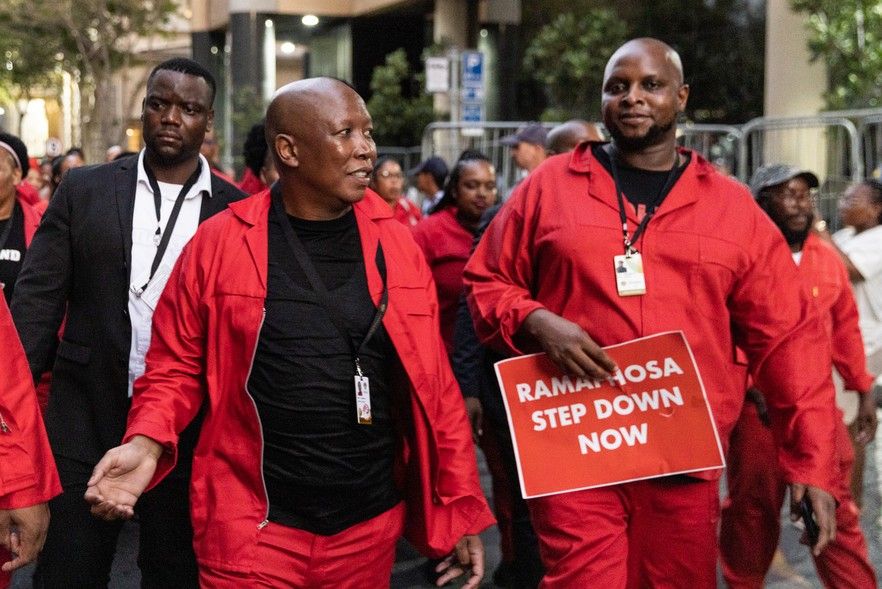
Finally, the loudest party in South Africa is the Economic Freedom Fighters (EFF), a self-described “Marxist-Leninist-Fanonian” group who have campaigned on issues of class and race since 2013. Leader Julius Malema was a former leader of the ANC’s Youth League, and his EFF was originally intended to play the same “radical conscious” role. However, in the decade-plus since, class has slowly slipped from the party’s platform, leaving the EFF resembling a single-issue party on race. In 2024, Malema made global headlines for a “Kill the Boer” chant breaking out at an EFF rally (“Boer” meaning a Dutch settler in South Africa), representing the party’s outlook.
While the ANC sought coalition partners in 2023, it entered a partnership with the EFF to run the civic governments of Johannesburg and Ekurhuleni. Despite the chasm between their platforms, both parties appeared interested in power-sharing, combining their electorates to constitute most of the country’s middle class. For the moderate DA, long deemed the “favorite” to join the government coalition, this set off numerous red flags. Leader John Steenhuisen called a possible ANC-EFF national government a “doomsday coalition,” and urged the nation’s other moderate parties to cooperate in preventing it.
Luckily for the DA, this rhetoric succeeded. When the Government of National Unity (GNU) was finally announced in July, the ANC and DA had joined forces as the largest parties making up the new coalition. After nearly two months of negotiation, including accusations by the MK of a stolen election, the ANC had “gravitat[ed] to the center,” according to its secretary general. In doing so, it did prevent the rule of the left-wing EFF and MK, but also admitted the far-right Patriotic Alliance (PA) into its new government.
With extreme ideological barriers between the ANC and DA, let alone the PA, the new GNU was admittedly fragile. Early rifts emerged in October with conflict over admitting Ukrainian immigrants, an issue that also heightened criticism from the MK-EFF opposition. The success of the GNU, then, will rely on walking a tightrope between two extremes. However, forces outside of South Africa have already created a crisis.
What’s At The End of a Rainbow?
On March 6, US President Donald Trump announced he would pull over US$436 million in funding from foreign aid to South Africa, citing “openly racist policies” and “egregious actions” by the country’s leaders, specifically the EFF’s Julius Malema. While not typically relevant to American politics, these issues have been brought into focus by South African billionaire and senior advisor to Trump, Elon Musk—so much so that, on May 22, Trump confronted Cyril Ramaphosa about untrue claims of “white genocide” in the Oval Office.
For a nation already struggling with unemployment and poverty, losing sources of income quickly becomes a nightmare scenario. South African officials have professed that they cannot work around the budget squeeze, and the future remains uncertain as South African and American officials work toward a reduced tariff. This tension has led to finger-pointing among the nation’s leaders, including Malema himself, accusing DA leaders of “seeking external intervention” and provoking Trump.
The issue has also created divisions within the unity government. In response to an ANC proposal to increase value-added tax (VAT) to fix budget issues, the DA not only took the ANC to court but also threatened to leave the GNU altogether if the tax was not reversed. While the tax was dropped in late April, this flare-up emphasizes how fragile the current government truly is.
If a future incident does cause the DA to leave, the EFF has offered to join the ANC in governing, a scenario that would be a massive upswing for populist leadership in South Africa. However, for now, the centrist GNU appears to be functional. In the year since its creation, it sits at 57 percent approval, despite its bloated size and lack of cooperation. Rebecca Davis writes that it is “kept upright not by conviction, but by consequence,” where any party that withdraws will be decimated in elections, and government collapse kills any remaining goodwill international investors and other peers may have.
For the first time in the nation’s free history, a party not named the ANC has helped rule the country. That party, being the DA, may have proven their capability even in this limited timespan. An April 2025 poll found the DA overtaking the ANC in support, with analysts attributing the shift (in part) to their vocal opposition to the value-added tax hike.
Part of this success has been winning Black voters. Their support jumped from 5 percent of Black voters last year to 18 percent today, a testament to both the DA’s growth and the possible weakening of race-based platforms like the EFF and MK. Yet, the DA could suffer if Trump’s pulled funding causes the GNU to slow, while the populist opposition may gain ground by criticizing dysfunctional incumbents.
The GNU remains a make-or-break government. For the extreme populist parties on both sides of the center, GNU failure is a dream come true. But if the government can succeed, the DA may be able to steamroll into a victory in 2029, setting up what should be the priority for South Africa: stability. Fixing unemployment, infrastructure, and poverty can only happen in a healthy government, and getting back on track requires shutting out the volatile extremes and eliminating corruption.