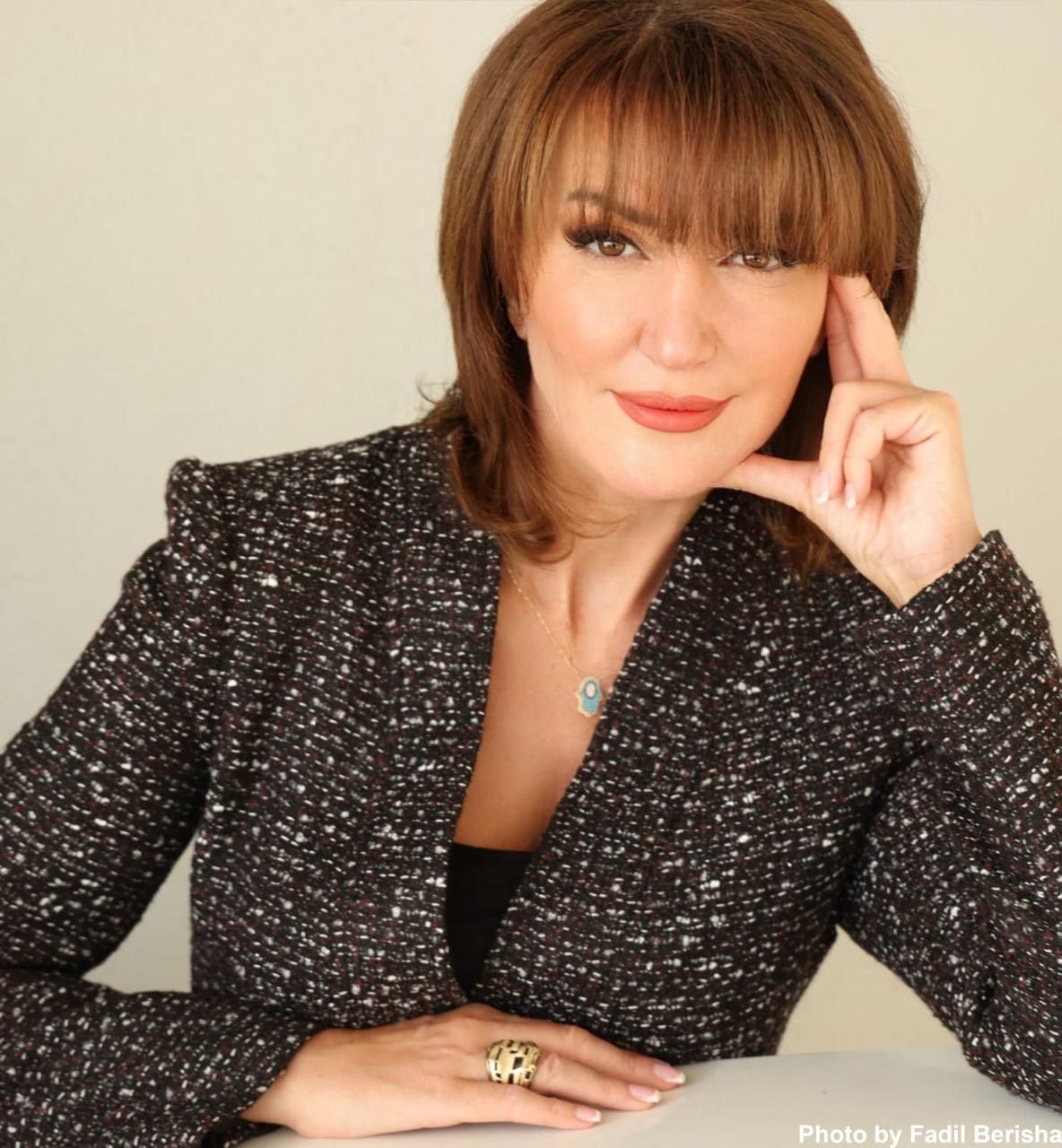
Madam Atifete Jahjaga served as Kosovo's fourth president from 2011 to 2016. She started her career in the military, attaining the rank of Major General of the Kosovo Police. Being just 35 years old when she was elected President of the Republic of Kosovo, Madam Jahjaga was the youngest head of state in the Balkans. During her time in office, Madam Jahjaga was a crucial advocate for greater international recognition of Kosovo’s independence, its involvement in international organizations, women’s empowerment, and post-war reconciliation. Today, she continues her work as a servant of the people through the Jahjaga Foundation.
As the President you decided to open the painful issue of war crimes and sexual violence. This happened after you met female victims who carried their wounds not only on the outside, but also on the inside, shamed as they were by societal norms. How did you manage to turn the discourse around, demanding accountability for the perpetrators and respect for the survivors?
Whenever I speak about the survivors of sexual violence I become very emotional. The reason being one particular meeting I had in the third week of my presidency, during which I met with a group of 35 female survivors of sexual violence in a village of Drenas, in the heart of Kosovo. I cannot say that I am the same person who went into the meeting and who came out of it. I heard the stories of these 35 women from Drenas, starting from looking at their bodies, where they had cuts on their faces, cuts on their bodies, marks of cigarette burns on their hands and on their legs, removed toes, and so on.
I heard the story of a mother who was in her early 40s—she was raped together with her three daughters. Her oldest daughter was 17 years old, the middle daughter was 15 years old, and the youngest daughter was not even 10 years old—she also had Down Syndrome. Her mother visited her that day, and she, unable to cope with what had happened to her, went outside, jumped into a well of water, and committed suicide. I met a woman who was six months pregnant when she was raped. She miscarried the baby and she could never again realize her dream of becoming a mother. And on, and on—stories which made me a completely different person after the meeting. I was in my early 20s during the war and my mother was in her early 40s. It could have happened to me, it could have happened to my mother, it could have happened to any one of us. I started our conversation mentioning that we have inherited a country that has left behind 20,000 women and men raped during the war time, when rape was used as a tool of war. That day I made a promise to them and to myself: that I will not leave even one stone unturned until the day that every single survivor who is ready to talk about their experience institutionally and socially will be provided with a platform for them to speak.
To our shame, as the people of Kosovo and the institutions of Kosovo, immediately after the end of the war, we have taken seriously our institutional and social obligations to all the different categories that came out of the war, but somehow, we did not consider our duty to the survivors of sexual violence. On the contrary, we pointed fingers at them, saying that it was their fault, that they asked for it, instead of pointing fingers at the perpetrators of these horrendous crimes. There was enormous stigma. It was considered taboo. We have covered them with a veil of shame instead of covering them with a veil of pride. We fought on many battlefields, but we never recognized that their bodies were turned into battlefields.
It took me a couple of months to thoroughly analyze my constitutional powers, because at the time, they were hardly waiting to send me to the Constitutional Court to remove me from my position. I stood firm because I had started something that I really wanted to see through to the end. These women were waiting for that institutional move, and it was my moral obligation beyond anything else, as the first woman to be elected president in Kosovo. If I would not do it—who would? Nobody had done this in the 12 years succeeding the war.
I am forever grateful to some of the women's organizations like the Youth Center Drenas and Medica Gjakova which have done things even under the radar when the institutions were not yet there. That is why I decided to establish for the first time in history, using the presidential decree, the National Council on Survivors of Sexual Violence during the War, in order to bring to the same decision-making table the government, the parliament, international organizations, diplomatic corps, women's organizations, women's rights activists, media, and everyone else to speak openly about the status of the survivors of sexual violence.
Within a month of work of the National Council on Survivors of Sexual Violence during the War, the law on war values had been amended—it recognized the status of survivors of sexual violence as civilian victims of war and opened a new institutional chapter for application, reintegration, re-socialization, access to free medical services, and access to justice. This last one is also related to the executive power of the president to appoint judges and prosecutors. At the time, I increased the proportion of female judges and prosecutors to over 50 percent to exclusively investigate and prosecute the cases of rape used as a tool of war.
Unfortunately, to this day, we have only two perpetrators who have been found guilty of using rape as a tool of war while culture of impunity prevails at a high level. We still lack an international commission, especially within the UN, on the use of rape as a tool of war. How come the international organization, which has as one of its main declarations the Universal Declaration of Human Rights, is violating this very declaration when it comes to the survivors of sexual violence? To me that remains an unresolved question. As such, it has been not only my moral obligation, but my task as the president from that moment on—it has become my personal mission to work around the clock for the survivors of sexual violence.
As the first female President of Kosovo you once said that you not only cracked but broke the proverbial glass ceiling. What was it like to hold such a prominent public position as a woman? What are the unique challenges that women face in political leadership in Kosovo, and how have they changed over time?
Although some matters certainly have changed from when I completed my mandate in 2016, I have to say that many things have remained the same. It is true, however, that Kosovo has not only cracked the glass ceiling, but it really smashed it altogether with the election of its first female president. Kosovo now has its second female president while also holding the largest percentage of women in parliament elected by the people—exceeding even the mandated quota. After all, Kosovo was one of the very first countries in the region to introduce a representative quota system for women at the local and central levels of government. While opinions on the policy may vary, I am a firm believer that quotas, particularly in transitional societies, are one of the greatest mechanisms that help us move from mere numbers to meaningful representation.
For instance, in the first three or four years of my mandate, my team and I had to deal with headlines focused on very superficial topics—what hairstyle I had, what bag I was carrying, what outfit I donned, and so on and so forth. The most extreme case was the posting of a photo montage of me half naked around the city. However, I never paid any attention to it. Did it affect me? Absolutely it affected me. Did it make me question things? Yes, it certainly has made me question many things. But it never made me go back on what I was unfolding. This was, at the end of the day, a strategy meant to interfere with my actions and goals—in particular when it came to speaking about women’s rights and the role of women within Kosovar society. There is a famous saying: what does not break you makes you stronger. I hung in there in order to set a different precedent and leave a meaningful legacy—especially for the young ladies, who were for me the main motivation to stay the course and create a path for them to follow.
In 2012 you hosted an International Women's Summit "Partnership for Change - Empowering Women", which was attended by more than 200 leaders from across the world, including the former US Secretary of State Madeleine Albright. The resulting Pristina Principles called for an increase in women's political participation. How much have these principles become a reality?
Back in 2012, Pristina and Kosovo rolled out the red carpet to receive over 200 leaders from around the world—from Canada and all the way to Australia. A country once overshadowed by dark clouds had now emerged into the favorable global headlines and the summit, for the first time hosted in Pristina at that level, had many positive outcomes—the Pristina Principles, G7 engagement, and many other activities. I am happy to say that not only were the Pristina Principles passed as the resolution in the parliament of Kosovo, but they also became a base of many of the initiatives of new laws, like the property rights laws, and amendments of many other laws. To this day, it is such a prominent document that it continues to be referred to and used as the base document for the improvement of the role of women in Kosovo society. On top of that, the Prishtina Principles have been requested to be used as the example for their incorporation into the legislative framework by the neighboring countries of North Macedonia and Albania.
You are not only active as a member of the Council of Women World Leaders, but also as an educator, you recently taught a course on "War, Nationalism, and Sexual Violence in Southeast Europe" at Dartmouth College. What is your main message to young women regarding their empowerment and female leadership?
Something that I learned early on in my career, about 30 years ago, is that you need to believe in yourself and your own potential, invest in yourself, and never allow anyone to discourage you. There will never be a thing in this world that you will not be able to do if you try it for yourself. There were numerous times when I would question myself, “Is this for me? Can I do that?”, and I would tell myself “No, it is not for me. I will never be able to do that.” Yet every time that I would listen to my gut feeling, even if I was advised not to do something and even if I doubted myself, I would come out more successful than I would have otherwise.
Likewise, never compromise the principles that you stand for. Because the moment that you tell yourself “I will make a little compromise only once and I will never do it again”, mark my words—that will only be the beginning. In the end, you will not know what you actually stand for. I never did that. Did it make things harder? Yes. Did it make me go extra miles? Absolutely. Even so, the end result was far better and much more rewarding.
Kosovo is not in the European Union but uses Euros as its currency, it is not in NATO but hosts the biggest NATO-led mission, it is not a member of international organizations but has most of them represented on the ground. Pristina is thus an international hub in its own right. How do you see the role of the UN today and its ability to address global challenges?
In my inaugural address as the President of Kosovo in 2011, I started establishing the strategic objective and destination for Kosovo—full EU and NATO membership and a strong alliance with the US. There is no other option for Kosovo, or for any other country in the region, than the full integration within the EU, UN, and NATO. Today, more than ever, we are seeing the importance of that. It is not about how big or how small a country is—each and every one of us has a role and a responsibility in the global arena.
In your 2011 inaugural address, you stated that in addition to EU membership the ideal of Kosovo is permanent friendship with the United States. How do you see the dynamic in relations between Kosovo and the United States?
Kosovo has as its final goal EU integration, NATO integration, UN integration, and a strong alliance and partnership with the US. Kosovo has maintained a strong alliance and partnership with the US, both before and after the war. I would not be here, living my life and speaking with you today, had it not been for the US and its people. They advocated for NATO’s humanitarian intervention to stop the genocide and ethnic cleansing in Kosovo back in 1999 and for the role of the US in Kosovo’s ongoing development since the end of the war to the present day. As such, the people of Kosovo, the institutions of Kosovo, and I are all eternally grateful to the entire international community, especially the US, for standing with the people of Kosovo during our most trying times.
At 35 years of age you were the youngest female head of state. Your father famously convinced you to take on the challenge by pointing out an individual's responsibility for the common good. You have since accumulated experience as a statesman, reformer and educator. Some therefore believe that you are too young and important to retire. Are you ready to reengage on the political stage or do you think it is better to lead from behind?
Being the President of the Republic of Kosovo and serving my country and my people has been the biggest honor of my life. The day that I handed over my duty as the President of Kosovo, I also made a public pledge, a promise, that wherever I be, or whatever role I take on, I will always be in the service of Kosovo and its people. Once a president,always a president. What I am doing now with the Jahjaga Foundation is exactly that—fulfilling my promise to the people of Kosovo and its institutions, serving them and the future of my country.


)