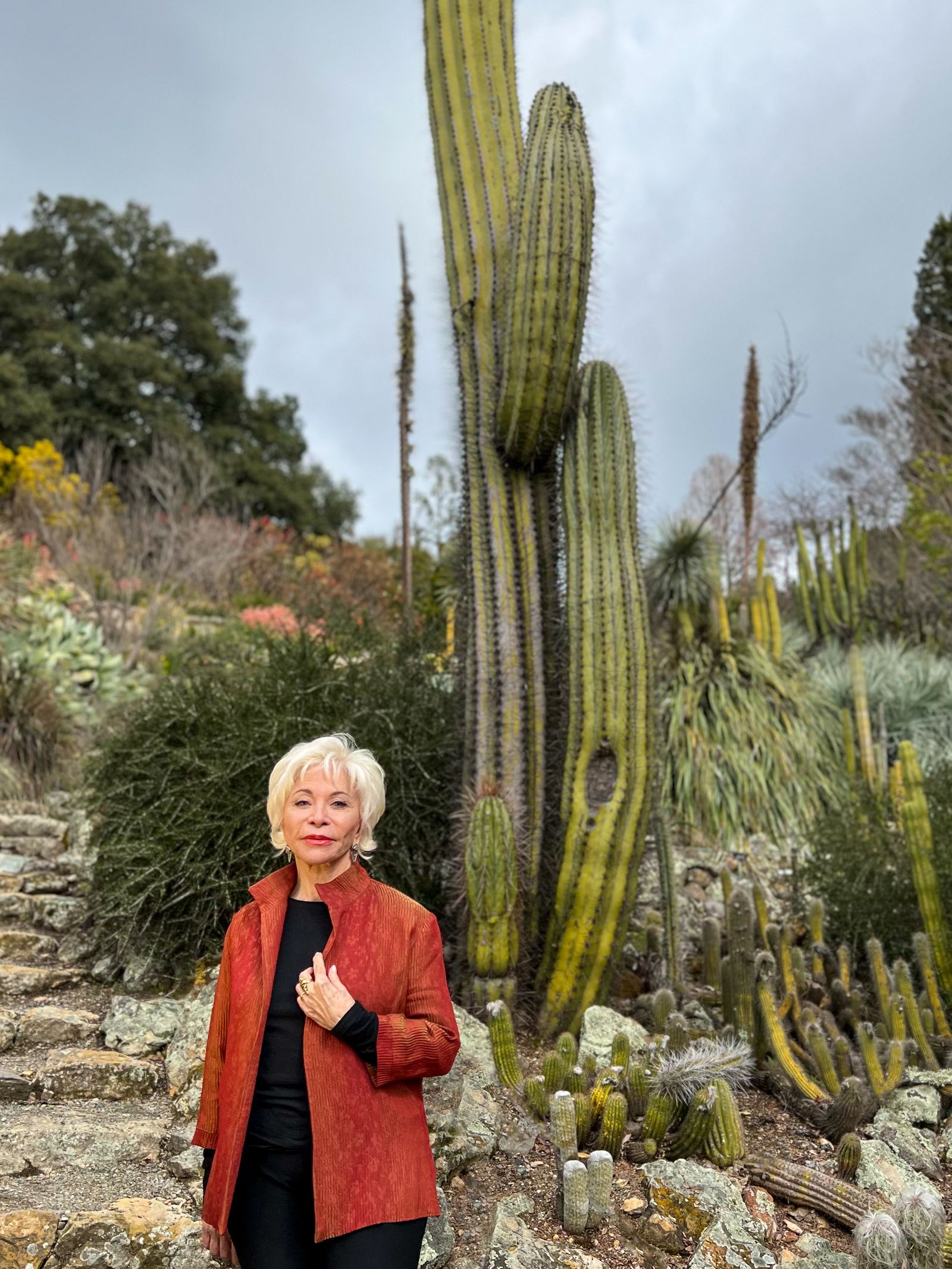
Isabel Allende is a Chilean-born novelist, feminist, and philanthropist whose books have sold over 80 million copies worldwide. She has written 28 bestselling works translated into more than 42 languages, including The House of the Spirits, Paula, Daughter of Fortune, and A Long Petal of the Sea. After her daughter’s death, she founded a global charity that supports women and girls and continues her human-rights advocacy. Her honors include the Presidential Medal of Freedom and multiple literary awards.
In The Wind Knows My Name, your most recent novel, you explored the inhumane treatment of the Trump administration towards immigrants. Now more than ever, these themes are relevant for the Latino community in the United States and beyond. If you were to write The Wind Knows My Name today, what would you, if anything, change? What stories need to be told now?
I wrote that story when Trump was elected, and he was president. Previously, things were bad, but they were not as bad as they are now. My foundation works on the border, so we support organizations and programs that are working with [immigrants directly].
The story of The Wind Knows My Name is the story of a little girl called Juana in real life, from El Salvador, whom I met through the foundation. The people who appear in the book—the social workers, the lawyers—are fictional characters only in the sense that I invented their names. I changed the names, and I sometimes blend two people to create one character, but they all exist. The story is real.
In many ways, today, the situation at the border would be way worse, because some of the programs we were supporting have closed for lack of funding, or fear. Many of the people whose paperwork was being processed are either afraid of being deported or have already been deported.
Even if you have papers, you can still lose everything. Even if you're a citizen—I am a citizen because I was granted citizenship—that doesn't make me immune to deportation.
Moving to your next novel, In My Name is Emilia del Valle, you revisit a turbulent period in Chile’s history while at the same time telling a story about finding home and belonging. When you write, do you look for home?
I don't know where home is. I feel like a foreigner everywhere. I was born in Peru and raised for a few years in Chile. Then, my mother married a diplomat. I traveled during all my adolescence. I spent a few years in Chile, married, and had two kids. I went into exile after the military coup, and I lived as a refugee in Venezuela for 13 years. Then, I came as an immigrant to the United States.
I am really comfortable. I like my house. I have family and friends, but I am a foreigner. I have an accent, and as I said before, everything is temporary for me. When I go back to Chile, I am really happy for a week, and then I realize that I do not belong there either. The experience of being abroad makes you different. The country has changed, and it changes all the time. I guess home for me is where the people I love the most are—and my dog.
When I write, I have an imaginary landscape in my head, an invented place. For example, in My Name is Emilia del Valle, the part of “the South,” is the south of Chile that I have visited many times and that I love. And if you ask me what the landscape of my dreams is, of my blood, it will be something like that. I have never lived there; I’ve just visited.
You only ever begin writing stories on January 8th as part of your ritual. You have many times explained the process that goes behind the beginning of a new novel, but I am puzzled by your ability to choose which stories to tell. What is a story you never wrote, but that dawned on you on January 8th? Does that story still live within you?
It's not every January 8 that I start a story. I only start another book if I have finished the previous one. Books can take many years. For example, Island Beneath the Sea, which is the story of the slave revolt in Haiti, is my longest book. I took two years of research plus two years of writing. Of course, I didn't have another book in the meantime. Other times, I can finish a book or two in a year because they are short books, or they are non-fiction. For example, The Soul of a Woman is a book about feminism. That's not fiction. I can write that quickly. During the pandemic, when there was nothing else to do, that is what I did—I published a lot.
As for which stories to tell, I have stories inside, like seeds, and then something starts bothering me, or I start thinking about it more and more. I wake up in the night and something is turning and turning, so I know that I have to pay attention. Sometimes I have more than one story. A couple of years ago, I had a memoir, and I had a book of fiction, Emilia. I put both on the screen, and on January 8, I started writing both. Then, I realized that [Emilia] was picking up, and I couldn't move the [memoir], so I left [the memoir] for later and I worked with Emilia.
I do have a story that I would like to write, but I have not been able to give it any shape in my head. It is the sequel to the House of the Spirits. That would be my last book.
The original book ends with Alba, who tells the story and has been tortured, mutilated, and raped. She is pregnant in a house in ruins, burying her grandfather. That is the end of the book. From there, it's 17 years of dictatorship. What happens to that woman, either in Chile or abroad? I think I want to tell more about what happened in Chile, the story of the country and the dictatorship, but I am not sure. So I am turning that in my head.
Your novels, in my experience, are characterized by these kinds of vast histories. Do you see yourself as a historian of your own novels? Why do you build a world so intertwined with actual history?
All my books are placed in some kind of reality. I cannot write fantasy. I cannot write romance stories or certain genres that are in limbo. My stories are always placed somewhere, not only in time, but in a place.
I like to write historical fiction, because if an event interests me and I research it thoroughly, I have half the book. I have the theater where my actors will move back to.
For example, let's consider My Name is Emilia del Valle. I was interested in the Civil War in Chile in 1891 as it had incredible parallels to what happened 80 years later in the military coup. In both cases, we had a progressive president who wanted to bring big changes to the country and incorporate the underprivileged, but within the frame of the constitution of democracy. It faced great opposition from the Conservatives, and the military intervened. In the first case, the military split, and we had a civil war started in the book; 80 years later, the military did not split, and we had a military coup and 17 years of dictatorship. In both cases, the President committed suicide. So the parallels are striking. Plus, in both cases, the United States was involved.
For me, those parallels were so striking that I wanted to research it. Once I researched the war, I had had half the book. History gives me the structure of the book. It gives me the tone and the setting.
When I was reading Emilia, something that I appreciated was that in writing historical fiction, you also tell the story of the people who were victims, those that were caught in the middle.
That's the most important thing. Where do you research? In libraries, on the internet: That version of reality is always told by the winners, always by the men, and usually white men. So you have a partial story.
You have to look for the silenced voices, for those who were defeated, for the poor, for the drafted soldiers who did not even know why they were fighting, the children, the animals. What happened to the mules and the horses?
You want to know the stories that are not told. Where do you find that? In newspapers, in letters, in journals, in fiction that has been written at the time. All that gives you the material that is not available in history books.
The most interesting part of the battle is how people felt—not the movement of the regiment, not how many bullets are, or how long the distance a bullet could go. What is interesting is the fear, the hunger, the thirst. How were the orders given in the middle of the chaos, without a walkie-talkie and without a phone? How did it happen? To investigate that is the most important.
Imagine a field hospital, with a table and the instruments for a carpenter to cut limbs. If there's little anesthesia or not, try to imagine the decisions, the mental distress, everything. And then nobody talks about the women who were on the battlefield.
Your novels are deeply political and moral but also personal and literary. Could you tell us about the relationship between politics and writing?
I never tried to give a message—I just did. I keep saying that to aspiring writers who tell me, I want to write about this and that because this is important: Just tell the story. Don't try to give a message, because you ruin it. The moral stand is the characters, and the angle that you take to tell the story. Try to avoid all the preaching.
Do you see your novels as advocacy or a statement?
That [tension] is why I choose certain stories: why am I always pulled towards the stories of marginal people, people who are not protected by the big umbrella of the establishment, the people who are the losers and who have to really struggle to survive? I'm attracted to that because I think the world is very unjust, and not everybody has the same opportunities or the same capacities or talents or background to succeed or to have a happy, or even normal life. The cruelty of the world, and its violence, is always [on] my mind. So that's what I write about.
Would you say all of your novels carry pieces of your life?
Once I heard an author say that the author is in every character. Pieces of the author are in every character and every story. Why do you choose to write about that? Why do you have to have those characters and no other characters? We are talking about literary fiction, not a genre like detective novels. I think that a lot of my life experience is in novels. For example, exile, immigration, being a foreigner, and being displaced.
You will never find in any of my books a loving father. You have substitutes, but never a father. What's wrong with me? Can't I write about a father? I do not have a father, so I can't even imagine a father, although my son is the best father in the world, and I had a wonderful stepfather. But a father, per se, I can't even imagine. And I always have strong women, because I don't know any weak women.
The person I am, what I think and and all my own experience, life, experience, and memories are part of what I write. They influence and feed what I write. But it's hard for me to write about myself directly. I have written memoirs. One memoir is called Paula. It's about my daughter's death, and that's my life, her life, and what happened in Chile. And then I wrote a sequel to that many years later, called The Sum of Our Days. Since 2007, I have not written about myself except about feminism.
Now I'm trying to write a memoir, and I find that very difficult. Why? Because fiction is a pack of lies. Fiction you try to achieve to get to some truth. Through lies, you make everything up. To get there with a memoir, your goal is the truth. So your fiction cannot get in the way, because then you lose the goal, which is introspection and reflection on what really is the truth. That, for me, is hard—because I'm a great liar.
That contrast, I think, is the key of the House of the Spirits. And on this topic of grief, you have been asked before about your famous quote, “Writing is a constant exercise in longing.” I wanted to ask, as an author, if writing is an exercise in longing, is reading too?
I think the readers find in a book what they already have inside. When a reader engages in a book, surrenders to the story, it is because there is something in the book that they already have inside.
I get a lot of letters from people saying, you changed my life. I read this, and then you changed my life.
No, I didn't change your life. I put in words what you already feel—what you already have inside you, but you don't know you have it until it is presented to you. That magical connection of the reader and the text happens only when there is something in the text that already is in the reader. I will never convince anybody of anything if that's not something that is already there, latent, like a seed.
I always feel that I preach to the choir, because the people who read my books already think like me. Do you think that a Trumpist will read my books? No, actually, my books are banned.
The House of the Spirits was banned in Chile during the dictatorship, and it was an honor. People would make, at the time, photocopies. I have seen the book in photocopy with the names of all the people that have read it [on the back]. That passing from hand to hand, that is so beautiful. It tells me many people are thinking like that. How many people agree with me: that is the best part.
Allende spoke with Wulff on October 5, 2025. This interview has been lightly edited for length and clarity.
The views expressed in this piece are the interviewee’s own and are not reflective of the views of the HIR.