
In 2023, the prestigious Italian Treccani Encyclopaedia chose “femminicidio,” Italian for “femicide,” as its word of the year.
The unconventional decision came after more than 100 women were killed in Italy in 2023 and more than half by their current or ex-partner. Femicide—a term referring to the murder of a woman on account of her gender—is a growing problem in the country.
Femicide is not an issue Italy is facing alone. A study conducted by the Mediterranean Institute for Investigative Reporting (MIIR) in collaboration with the European Data Journalism Network (EDJNet) estimated that at least 4,221 women were victims of femicide in Europe between 2012 and 2022. Furthermore, since 2019, Greece, Slovenia, Germany, and Italy have seen significant increases in femicide cases, and Greece exhibited the highest in 2021 with an increase of 187.5 percent from 2020.
Physical violence has also fueled safety concerns. The Annual WIN World Survey showed that 45 percent of women in Europe do not feel safe, with Italy reporting the highest percentage of 63 percent.
Gender-based violence is deeply rooted in gender inequality, and it is a common violation of human rights. Femicide is a societal problem bolstered by broader dynamics of oppression and violence. Although solutions must focus on protecting women, eradicating femicide will benefit society at large.
Renewed interest: the case of Guilia Cecchettin
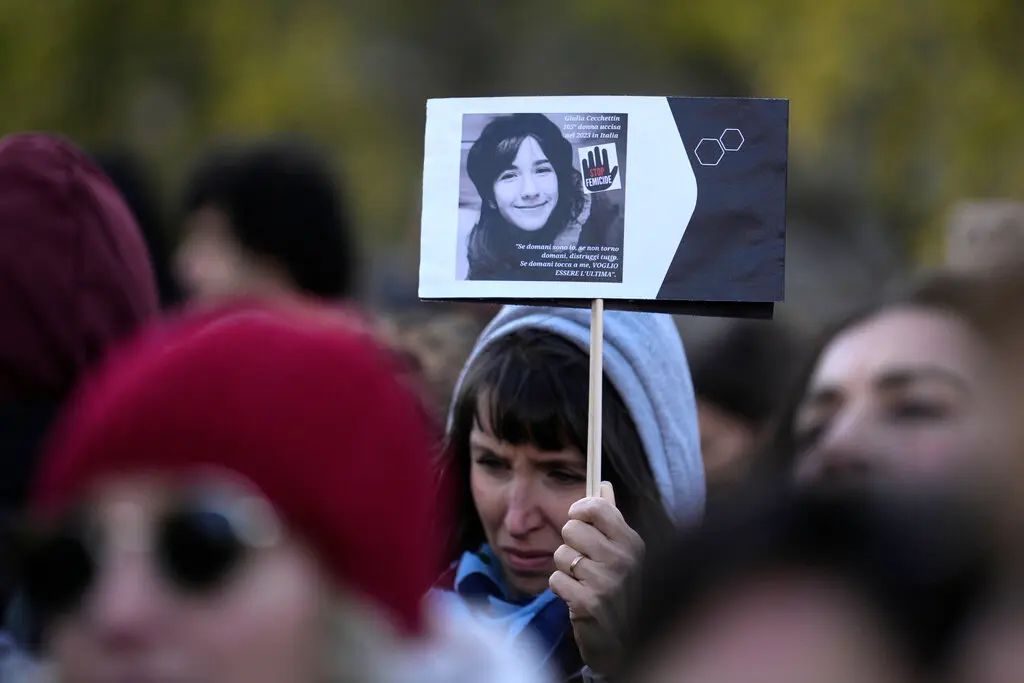
In November 2023, a singular case renewed concern about femicide in Italy and brought this issue once more into the spotlight. Giulia Cecchettin, a 22-year-old biomedical engineering student at the University of Padua, was murdered by her ex-boyfriend, Filippo Turetta, with her body discovered at the bottom of a ditch. Turetta stabbed Cecchettin over 70 times. Both were enrolled in the same institution, and Cecchettin was murdered a week before her graduation.
The event sparked great outrage, with tens of thousands of people coming out to organize protests, processions, runs, walks, flash mobs, sit-ins, and even free gynecological examinations. More than 10,000 people attended Cecchettin’s funeral.
After her sister’s murder, Elena Cecchettin gave a powerful interview in which she described Turetta not as a “monster” but as “the healthy son of a patriarchal society.” Giulia Cecchettin’s father, Gino, also linked the murder of his daughter to Italy’s patriarchal society: “If you’re a man you’re part of a system that teaches you that you are worth more than women…It means that if you’re in a relationship everything needs to go through you... and so a patriarch can’t be told: ‘I don’t love you anymore’, because it goes against his sense of ownership.” Comments from Giulia Cecchettin’s family members therefore contributed to Italy’s national reckoning with patriarchy and misogyny in the wake of the murder.
On December 3, 2024, Turetta was sentenced to life in prison—which is no more than 30 years in Italy—after a 10-week trial. The slow turnaround between the crime and the trial suggests a lack of attention and urgency on part of the judicial system, despite how Turetta’s crime gripped the country.
Current Prime Minister Giorgia Meloni’s government has also drawn criticism for its insufficient efforts to combat femicide—most notably from Elena and Gino Cecchettin, who founded the Giulia Cecchettin Foundation to combat gender-based violence. Governmental officials have denied that the patriarchy is still a problem in Italy, stating that sexual violence is “linked to the marginalisation and perversion that stems from illegal immigration.” Elena Cecchetin poignantly responded to these comments: “Giulia was killed by a respectable, white Italian man. My father has done something to prevent violence. What is the government doing?”
Femicide and politics: female leadership, the “female fear factory,” and crimes of power, not passion
Femicide has far-reaching impacts beyond victims and their loved ones, especially in the realm of politics. Gender-based violence deters women from political participation and leadership, serving as a form of regulatory “punishment.” At a time when equal participation and leadership in political and public life are essential to achieving the UN Sustainable Development Goals by 2030, violence preventing women from achieving positions of power has even graver implications.
Femicides affect the way a society functions. South African scholar Professor Pumla Gqola coined the term “female fear factory,” which exemplifies how gender-based violence is a perpetration and exercise of power. Gender-based violence—and the normalization of such cases—creates an atmosphere of fear that prevents challenges to the status quo.
With femicide happening most commonly in close or pre-existing relationships, many cases have been wrongly named as “crimes of passion,” fueled by jealousy or the inability to accept breakups, among other factors. However, Elena Cecchettin, Guila Cecchettin’s sister, has expressed a need to change this outdated framework of thinking. For her, the killing of her sister was not a crime of passion, but one of power, similarly to the conditions described by the “female fear factory.”
Definition is recognition: outdated and incomprehensive legal structures in the European Union
With femicide being such a pressing issue, there should be great legal support to prevent future cases. However, only five countries in Europe—Cyprus, Malta, Belgium, North Macedonia, and Croatia—have legally defined femicide as a distinct crime.
Other countries have taken different approaches. In Italy, following the Guilia Cecchettin case, a new law combatting femicide entered into effect in December 2023. Titled “Provisions for Combating Violence Against Women and Domestic Violence,” the law broadened the definition of unlawful conduct related to domestic violence, increased penalties for crimes related to domestic violence, and added special protections for victims of domestic violence, among other provisions. While these efforts focused on domestic violence implicitly address femicide, murder on the account of gender still needs to be legally considered an issue in its own right. Focusing on domestic violence without explicitly naming and targeting femicide downplays the systemic component of the problem.
Beyond legal definitions, it is important to consider the application of the law. Elena Biaggioni, lawyer and vice president of Women on the Net Against Violence (D.i.Re)—a national anti-violence network run by women’s organizations—stressed that the effective application of existing laws against gender violence is of paramount importance. Biaggioni also argued that law enforcement needs to be coupled with cultural approaches: “The problem is structural and steeped throughout all of society. And modifying cultural paths takes time and requires action on many fronts.”
The next step: the need for legal harmonization in the European Union
By making the collection and interpretation of data easier, recognizing femicide by its own name across all European states is an important step in the fight against it. The MIIR and EDJNet study faced issues when researching, stating that the end figure for total femicides in Europe is a massive underestimate. The institutions could not find data for eight member states: Poland, Bulgaria, Ireland, Denmark, Luxembourg, Belgium, Portugal, and Romania. Furthermore, information used to identify femicides—such as whether the homicide occurred following an incident of sexual violence or whether the dynamic between victim and perpetrator was hierarchical—is rarely available, which makes effective measurement of femicide rates difficult. With each EU country using different categories and definitions, harmonization is of great urgency.
It is important to correctly remember victims of femicide. Giving such cases specialized attention can be a form of collective action towards their reduction. Femicides have ripple effects on all women in the surrounding community. Combatting this issue will not only have positive implications for women, but also for the political and social well-being of society.