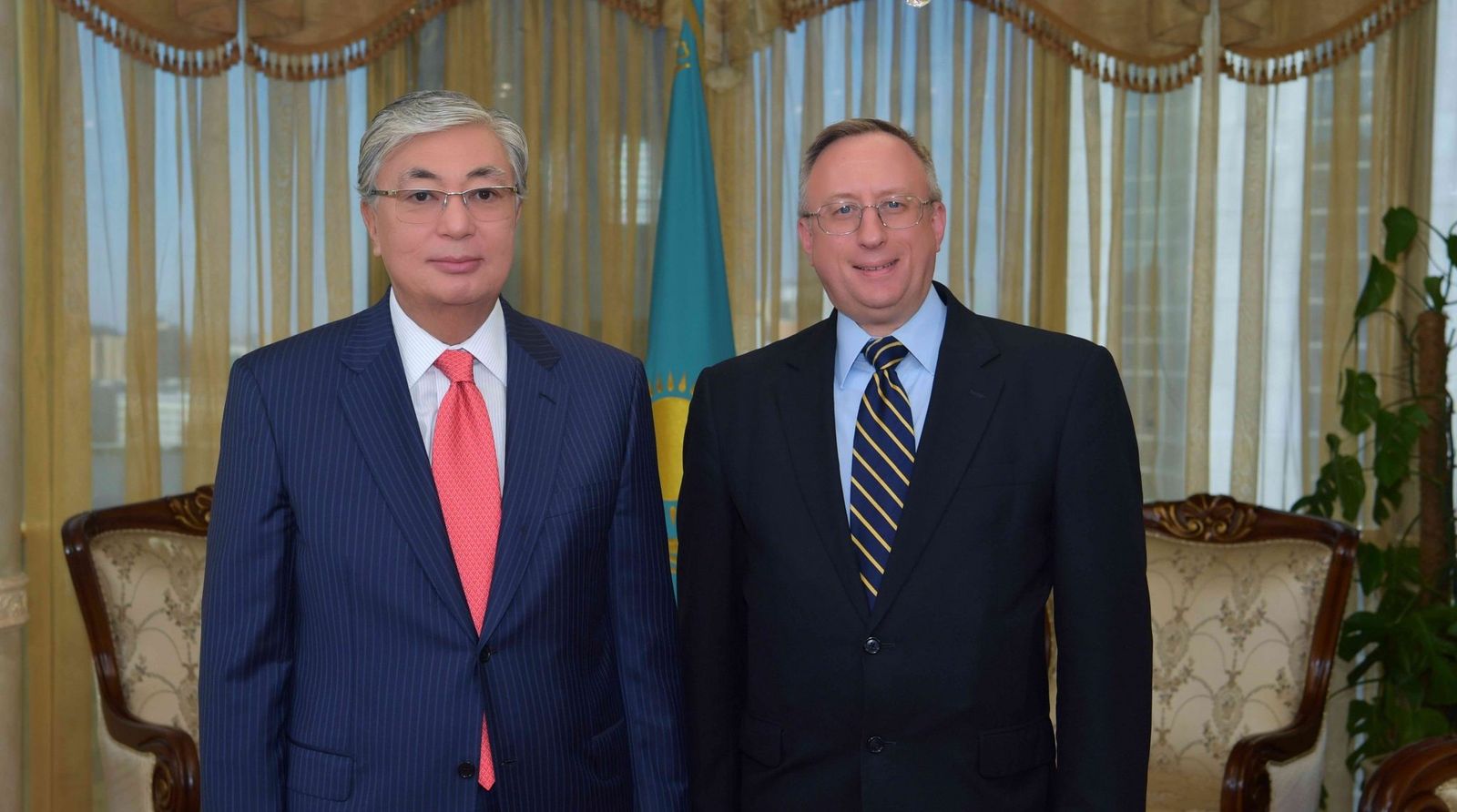
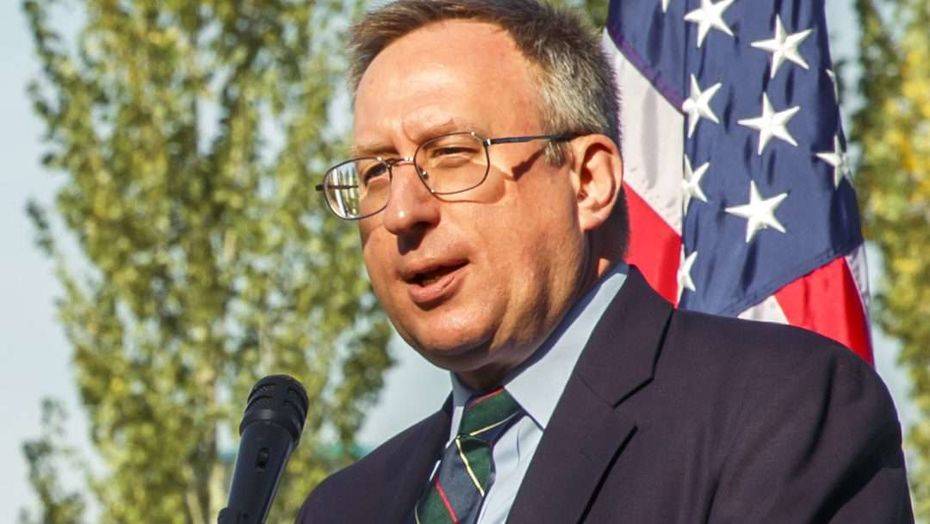
Ambassador George Krol is a senior U.S. foreign officer, who served as the U.S. Ambassador to Belarus, from 2003 to 2006, to Uzbekistan, from 2011 to 2014, and to Kazakhstan, from 2015 to 2018. He completed his undergraduate studies at Harvard, as a resident of Quincy House, in 1978 and began his career in the U.S. Foreign Service in 1982 and was posted to Poland, India, USSR, Ukraine, Belarus, Russia, Uzbekistan, and Kazakhstan. He served as Special Assistant to the Ambassador-at-Large for the New Independent States and as Director of the Office of Russian Affairs. Prior to his nomination as Ambassador to Uzbekistan, he also served as the Deputy Assistant Secretary for the Bureau of South and Central Asian Affairs. He retired from the Foreign Service in 2018 after completing 36 years of service. Today, he teaches as an Adjunct Professor at the U.S. Naval War College and is a Local Affiliate of Harvard’s Davis Center for Russian and Eurasian Studies.
Central Asia is positioned at the crossroads of major powers’ interests, including Russia, China, the U.S., Turkey, and the EU. How do you assess the current balance of different influences in the region, and what dynamics are most likely to shape that balance in the future?
At the current time, Central Asia is important to Russia—it is a mutual dependence that they have. But Russia had somewhat taken Central Asia for granted before the war and before all the sanctions. This despite the fact that it was attempting to bring Central Asia, its economies, and trade into the Eurasian Economic Union, which comprises Kazakhstan and Kyrgyzstan. China, of course, has been developing economic ties readily and has made announcements of major investments, including for the construction of pipelines and railways. However, it is uncertain how long this will last if the Chinese economy will have to pull back on its external investments in order to address its own economic challenges. Similarly with Russia too. Overall, Russia and China, being the immediate neighbors, still have a great deal of influence in the region, though that influence may be weaker than in the past.
Central Asia was never a critical region of interest for the United States, except when it came to its policies on Afghanistan, Russia, or China. But the current American administration is looking at it as a place for obtaining and making deals for rare earth minerals in particular, and as an area for business in general.
The European Union is one of the largest investors in Kazakhstan, and it is also very interested in Uzbekistan. It even has a special envoy for Central Asia to promote its interests. Individual European countries also have their own interests in the region. Spain, for example, has been especially successful in selling railways and railway equipment to Uzbekistan. The EU may be seen as less of a power in itself, because it is not so much a centralized player like the other states in the region. Turkey also appears to be trying to improve its position in Central Asia.
Although the important thing to consider is that Central Asians themselves are starting to work more as a region, among themselves. After the breakup of the Soviet Union, they all prioritized independence and sovereignty within their own countries, thus they did not really get along with each other. All of those connective tissues of the Soviet period that brought them together were frayed or done away with. They did not want to talk about integration. They wanted to talk about their own independent economies as sovereign states. That, of course, made them vulnerable to outside influences aimed at keeping them apart.
Now, things are different. The Central Asian leaders just recently held their seventh consultative meeting in Tashkent, in which they also included Azerbaijan. They have been able to resolve their own conflicts and work more closely together. Institutionalization of these relations will be a major development, where it will be Central Asians working in concert with each other to pursue their own benefits. Of course, they have internal problems. There is Turkmenistan, which does not really want to play along, but perhaps feels that it has to. Although this is still an evolving situation.
So the relationships of outside powers with Central Asia have evolved, but more importantly, the ties between Central Asian states have evolved in such a way that they have emerged as players in their own right in determining the future of the region.
Central Asian leaders made a decision to formally expand the C5 framework to include Azerbaijan. What other role do you expect Azerbaijan to have within the broader US considerations for its engagement in Central Asia? What do you think a C6+1 framework implies for future international engagement, and do you foresee any other neighboring countries joining the group in the future?
The addition of Azerbaijan certainly comes from the central Asians themselves, after all, it is a mutual framework, though it was originally suggested by the United States. The United States was rather a latecomer to the C5+1 format. The Japanese, Chinese, Koreans, and other states had long had this kind of cooperation program. At first, these meetings were largely just an opportunity for the United States to speak with all of the Central Asian states and show some level of interest. It was only the US Secretary of State, John Kerry, who visited the region for the first time and met with all the regional leaders. But what were the results of this meeting? There were some small projects that were financed partly through already-existing programs that USAID was financing that were included in the C5+1 rubric, and efforts to develop some cooperation among the five countries, with some input from the United States. But this changed over time. Azerbaijan’s membership in the framework has largely been facilitated by the growing interest in the Middle Corridor, some US encouragement, and sustained Azerbaijani lobbying for inclusion. Azerbaijan previously had a more strictly bilateral relationship with the United States, so the inclusion in a broader regional cooperation effort is likely perceived as beneficial.
At first, the Central Asians were rather uninterested in including anybody other than the five selves, especially the US effort to include Afghanistan in the C5 framework. Though the Central Asians did not want to do that, the United States really was pushing this idea, believing that it could be helpful for Afghanistan to be integrated into the regional group. So who knows, perhaps in the future Afghanistan may become part of at least the regional C6 group, which now also includes Azerbaijan—this is the framework for regional cooperation that facilitates the yearly Consultative Meetings of Heads of State of Central Asia and that the states have been working on for the last seven years, which looks like it may become something more institutionalized than a simple meeting place for the leaders. Though the group has made announcements that sound very impressive, it mainly functions as a forum for bilateral meetings.
There was recently a meeting at the White House in Washington celebrating the 10th Anniversary of the C5+1 that did not, however, include Azerbaijan. It promoted trade with and investment in the United States by the Central Asian countries, rather than limiting engagement to US involvement with the regional states, giving the initiative a more dynamic character. Furthermore, the fact that US President Donald Trump met with the Central Asian leaders in the White House over dinner was considered an important development. Though most of this could just be for show. What will really come of this relationship? Will there be actual contracts signed? And what will be the format of including Azerbaijan into the framework? After all, in the US Department of State, Azerbaijan is still in the Bureau of European and Eurasian Affairs while Central Asia is in the Bureau of South and Central Asian Affairs.
At the same time, Azerbaijan is not in the same bureaucratic framework. This makes dealing with and bringing Azerbaijan into the program a little difficult. Furthermore, Azerbaijan is within the purview of the US European Command, whereas the Central Asian states fall under the US Central Command. So, if there is to be a security dimension to the framework, then the American bureaucracy will have to sort out these matters first. That adds another wrinkle to the issue. However, if it simply remains a matter of trade and investment—which seems to be the focus of the current administration—that may be easier to deal with through the Department of Commerce.
On November 6th, 2025, Trump hosted the leaders of five Central Asian republics at the White House for the tenth anniversary of the C5+1 group—the result was the signing of various deals worth billions of dollars. How do you evaluate the Western policy toward Central Asia over the past two decades? What adjustments would you recommend to strengthen American engagement in a region that is often overshadowed by its neighbors?
Aside from the meeting that Trump had, the US delegations have also held meetings with Central Asian heads of state. Sergio Gor, who holds both hats as US Ambassador to India and the Special Envoy for Central Asia, met with his Kazakh and Uzbek counterparts this past October. It's business—they want to develop business ties. And the Secretary of Commerce, Howard Lutnick, has been deeply involved in trying to negotiate a deal between an American company and Kazakhstan on a mineral deal. But the devil, as we say, is in the details. Will there be contracts that will come out of these announcements of the intentions for developing relations? Whether these billions of dollars will actually materialize for both sides remains to be seen.
Looking back, when there was a great deal of interest in Central Asia and its mineral development in the 1990s, many foreign companies came to the region. Some of the American companies were partnering in mining in Uzbekistan and elsewhere, while the Canadians were involved in the Kumtor gold mine in Kyrgyzstan. However, all those deals fell apart because they came from companies that wanted to control their investments, and they were basically forced out by their local partners, which were trying to ensure that the gold mines would be controlled by the Uzbek and the Kyrgyz governments, respectively. Early enthusiasm and investment turned sour because the American mining companies had to litigate to get compensation after their shares had been nationalized. There is no firm guarantee of a deal going a certain way. The government can say “We guarantee you this sort of deal,” but what the government giveth, it can taketh away. So these kinds of companies tend to be very wary of doing business in places where they do not feel that there are adequate security guarantees for their investments, especially because the legal system is controlled by the government’s interests, and the government will not grant full control to a foreign entity.
The exception to the rule was when Chevron and Exxon Mobil—the main energy companies—were able to sign the “deals of the century” in the early 1990s with the Kazakh authorities, which gave them a great deal of privileges and benefits, which they have been reaping over all these years. But those deals are now up for renewal, and there are questions from the Kazakh government as to whether they want a greater share of these deals, which they apparently did not from the 1990s on. When I was in Kazakhstan, these companies were always faced with a certain form of extortion from local governments, wanting more from them by denying them licensing, all to obtain more money. Many of these businessmen had to go to the President of Kazakhstan himself to resolve the issue if it became that serious. Otherwise, they would just chalk it up as the price of doing business in Kazakhstan. Since the United States does not have a government-directed economy, the businesses themselves have to decide whether or not they will risk their capital and investments in these places.
During Donald Trump’s first administration, when I was ambassador to Kazakhstan, there were also trade missions that came from the United States, thinking that they could do business in Central Asia, particularly in Kazakhstan. But nothing really came of it. They came, they looked, and they decided: no, not now. I do not know what has changed that will cause them to invest a lot without knowing the security of their investment. So that still is an issue for Western, and particularly US, development of economic interest in these countries. The same goes for the Europeans. Even the Chinese have often complained about this themselves. But since their businesses are more tightly controlled by the government, their government can say “Thou shalt invest, thou shalt build,” and the companies have to oblige, even if they incur a loss—that is the Chinese business model. They are business people, and they would like to make money, but if they have to lose money in order to secure a geopolitical advantage for China, they will do so because they must. The same applies to Russia. As for Turkey, its economy is becoming more and more controlled by the government as of late. So there is a particular interest as well for Turkish businesses, whether or not it will benefit them. That is something that I think is still an issue for the attractiveness of doing business in Central Asia.
On the other hand, compared to the rest of the world, Central Asia is a pretty stable region. It has not seen major disruptions or violence. And as I said, they are resolving their own border issues and conflicts among themselves, through their own mediation efforts, which I think is important, and they could also resolve the kind of economic barriers they themselves had directed against each other—the customs, the border controls—to have more of a free market within the region. Including Azerbaijan in the group could contribute to this process. Furthermore, the creation of an institution that can guarantee the reforms could make the whole region more attractive, and not simply individual countries. Such a development would be important for foreign and local investors because it would show that the region is able to resolve its own problems while maintaining social and economic stability. These regimes, while they may be authoritarian, have been pretty successful in maintaining their overall stability—both domestically and externally—and in managing relations with their big neighbors, north, south, and east, including the United States.
Looking ahead, what role do you see Central Asia playing in global security, whether in counterterrorism, nuclear nonproliferation, or regional conflict mitigation? How should the international community support this role?
The Central Asian countries evolving as a region and resolving their conflicts among themselves will perhaps lead to the development of common diplomatic and cooperative policies to deal with the mentioned issues of global security, particularly counter-terrorism and counter-extremism. They may develop a cooperation strategy for their security and intelligence services to deal with the influence of Islamic fundamentalism, which has already infiltrated neighboring Afghanistan.
One concern that arises is whether Islamic fundamentalism has infiltrated Central Asia. There has been some sense that it might have, but the regional governments are focused on assessing and controlling the domestic situation, and they share information with one another to ensure none of them become hotbeds for these types of ideological groups. The local leadership knew that there were some Central Asians who would go to Syria or Iraq and join ISIS, and they have been trying to re-educate some of those returnees and their families. The Central Asian states are quite assiduous in trying to control influences they believe could encourage citizens to join such groups and later return with the intention of promoting Islamic State-related activities within Central Asia. The Uzbeks have always been concerned because they have a large population, particularly in the Fergana Valley, which was highly religiously motivated for decades. So much so that even the Soviets struggled to keep it under control.
Another prominent issue is that of non-proliferation. There are still remnants of the Soviet nuclear and biological experiments on Central Asian territory. In the case of the Aral Sea, Uzbekistan and Kazakhstan have been working together to protect and restore the area. Incorporating Kyrgyzstan, Tajikistan, Turkmenistan, and perhaps even Azerbaijan into this collaborative framework would be a major development for Central Asia that could transform the region into a player rather than a playground for outside powers.
The United States has programs with each individual Republic, though it has long supported the regional approach. The idea behind the C5+1 framework was to facilitate conversations among the countries. The Trade and Investment Framework Agreement signed in 2004 was meant to ease trade and reduce restrictions between the Central Asians, to prevent them from being hived off from or pitted against one another, and to increase their prosperity through cooperative work.
This sort of framework still appears to be attractive to the Central Asians, and it could facilitate them taking charge of their region, better equipped to manage their economic and political trajectories. This will be particularly pertinent if the recent meeting in Tashkent leads to the creation of institutions that will actually produce tangible effects, rather than simply being a space where the bureaucracies can converse while still pursuing their own national interests. In the end, these countries will still want to ensure their independence and sovereignty. Much like in the EU, there will still be tensions between the countries that have their own interests in mind.
Krol spoke with Benedejcic on December 19, 2025.
This interview has been lightly edited for length and clarity. The views expressed in this piece are the interviewee’s own and are not reflective of the views of the HIR.



)